Full mouth dental implants can replace a full upper arch, lower arch, or both with implant-supported teeth. For people with extensive tooth loss or teeth that cannot be predictably saved, they can provide a more stable and natural-feeling option than removable dentures, but candidacy depends on oral health, bone support, medical history, and treatment goals.
If you are trying to replace a full upper or lower arch, learning how dental implants work can help you compare fixed and removable options with more confidence. University Dental Implant Center in San Diego, CA helps patients understand which implant approach may best restore comfort, function, and long-term stability.
Severe tooth loss often develops from advanced gum disease, extensive decay, trauma, failed dental work, or certain medical and developmental conditions. When many teeth are missing or failing, chewing, speech, appearance, and diet can all become harder to manage.
After teeth are lost, the jawbone in those areas gradually shrinks because it no longer receives stimulation from tooth roots. Implant-supported restorations transfer chewing forces into the bone and may help preserve available bone, although they cannot reverse every change that has already occurred.
A dentist may recommend full-arch treatment when most or all teeth in an arch are missing, painful, loose, or have a poor long-term prognosis. Teeth should not be removed just to simplify treatment if they can still be predictably preserved.
A fixed full-arch restoration uses several implants to support a bridge that stays in place and is removed only by a dental professional. The exact number and position of implants depend on bone anatomy, bone quality, bite forces, and the design of the final restoration.
Some fixed approaches use angled implants to take advantage of available bone and may reduce the need for grafting in selected cases. Terms such as All-on-4 describe a treatment concept, not a guarantee that four implants or immediate teeth will be right for every patient.
For a closer comparison of common full-arch approaches, see All-on-4 vs. All-on-6. In some cases, options such as All-on-8 dental implants may also be considered based on anatomy and restorative goals.
An implant-retained overdenture is removable by the patient but attaches to implants for better stability than a conventional denture. It often costs less than a fixed bridge and can be easier to clean, though it may still have some movement and usually needs periodic replacement of attachment parts.
Conventional complete dentures do not require surgery and may be appropriate when implants are not desired or medically advisable. They usually provide less chewing stability, especially in the lower jaw, and they do not prevent the bone changes that follow tooth loss.
Evaluation usually includes an oral exam, dental imaging, a bite assessment, and a review of health conditions, medications, tobacco or nicotine use, and past dental treatment. A cone beam CT scan may be used to create a three-dimensional view of bone volume and nearby nerves or sinus spaces.
Candidates need enough healthy bone to support implants or a realistic plan for bone grafting. Active gum disease, untreated decay, and oral infection generally need to be controlled before final implant treatment begins.
Conditions such as diabetes, osteoporosis, immune disorders, prior radiation to the jaws, and medications that affect bone healing do not automatically rule out implants, but they can change risk and treatment planning. For more detail, see dental implant success factors on how these issues may influence outcomes.
Smoking and nicotine use can raise the risk of delayed healing, infection, and implant failure. Patients may be advised to reduce or stop nicotine use before and after surgery.
A patient also needs to be able to clean around the restoration and return for maintenance visits. Clenching or grinding may require design changes and use of a protective nightguard after treatment.
Planning starts with records such as scans, photographs, and impressions or digital scans. The restorative dentist and implant surgeon may coordinate treatment so implant placement supports the planned tooth position, bite, and facial appearance.
If failing teeth must be removed, implants can sometimes be placed at the same visit. Bone grafting may also be done before or during implant placement, although larger grafts may need several months of healing before the next phase.
Some patients can receive a temporary fixed bridge on the day implants are placed, often called immediate loading or described as same-day teeth replacement. Same-day teeth are temporary teeth, not the final restoration.
Immediate loading is only appropriate when the implants achieve strong initial stability and the bite can be carefully controlled. Healing still continues for months as the implants integrate with the jawbone through osseointegration.
Depending on grafting needs, infection control, and healing speed, full treatment may take several months to more than a year. The final bridge is usually made after the implants and soft tissues have stabilized.
Implant surgery is commonly performed with local anesthesia. Sedation may also be considered when appropriate after reviewing medical history, safety factors, and transportation needs.
Swelling, bruising, tenderness, and minor bleeding are common early in recovery and should gradually improve. Patients are often asked to follow a soft-food diet and avoid putting too much pressure on a temporary bridge while healing occurs.
The dental team should provide specific instructions for hygiene, activity, diet, and medications. Following those instructions closely can help protect the implants during the early healing phase.
Contact the treating dentist or surgeon promptly if pain or swelling worsens after first improving, bleeding continues, fever develops, pus appears, a bad taste occurs with swelling, or an implant or bridge feels loose. Difficulty breathing or swallowing, rapidly spreading swelling, or uncontrolled bleeding requires urgent medical care.
Full mouth dental implants cannot get cavities, but plaque can still inflame the surrounding gum and bone. If that inflammation progresses, peri-implant disease can lead to bleeding, bone loss, and eventual implant failure.
Daily care may include a soft toothbrush, floss made for bridges, interdental brushes, or a water flosser, depending on the design of the restoration. For step-by-step guidance, see dental implant cleaning.
Professional maintenance is usually needed at intervals based on gum health, plaque control, medical risk, and any history of periodontal disease. The dentist may check the bite, clean hard-to-reach areas, take periodic X-rays, and look for wear, loose screws, damaged parts, or tissue changes.
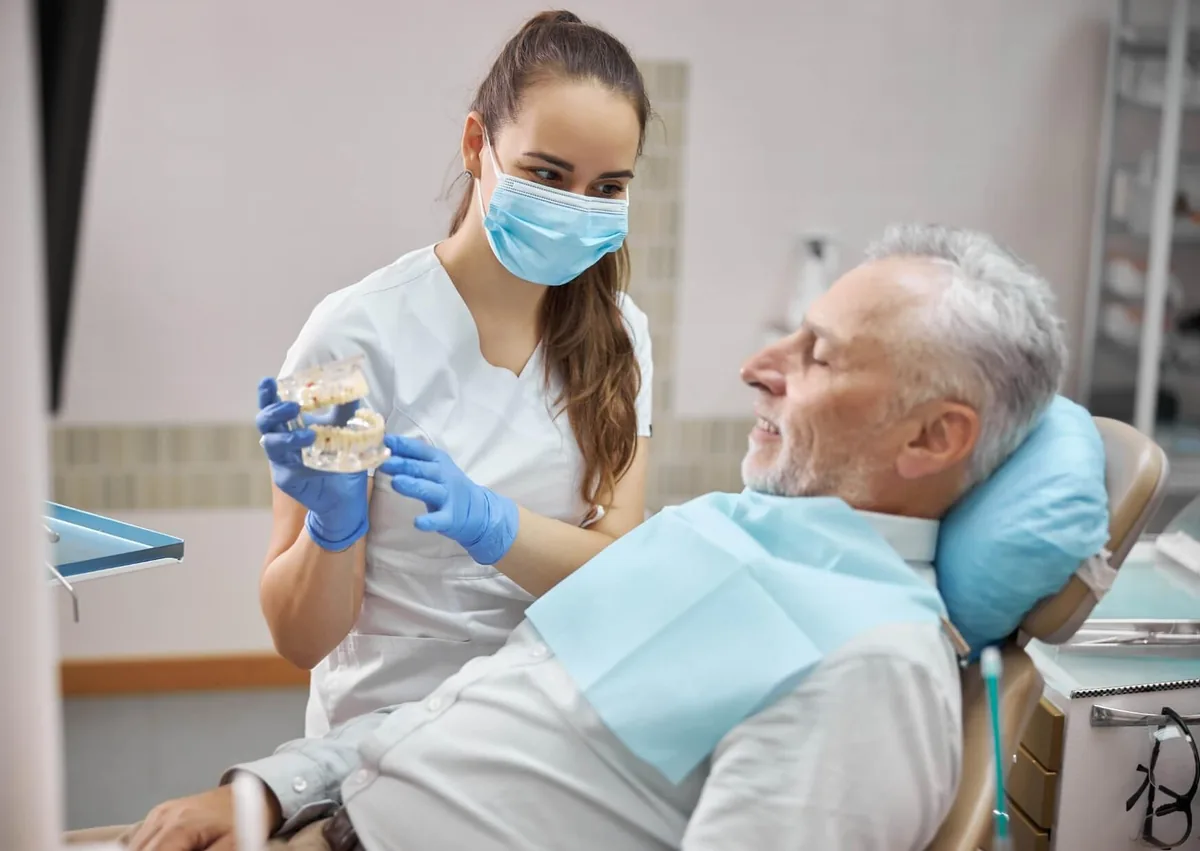
Implant-supported teeth can improve stability, chewing ability, speech, and confidence compared with poorly fitting dentures. A fixed bridge also stays in place, although it still requires careful cleaning underneath.
Implants and restorations are not lifetime guarantees. Implants may fail to integrate or may lose support later, and bridges can chip, stain, wear, loosen, or need repair or replacement over time.
Treatment also involves surgery, healing time, maintenance, and potentially substantial cost (see cost of dental implants). Results vary based on anatomy, health, hygiene, nicotine exposure, and bite forces.
A consultation is worth scheduling when several teeth are missing, dentures feel unstable, or remaining teeth are painful, loose, or repeatedly failing. Earlier evaluation may help preserve more treatment options before bone loss or dental breakdown becomes more severe.
To determine whether implants, All-on-4, or an overdenture best restores function and comfort, arrange a consult so the team can evaluate your jaw, health, and goals. University Dental Implant Center focuses on dental implants in San Diego, CA and nearby La Mesa, CA; call (619) 582-4224 to schedule.
No. Full-arch bridges usually replace many teeth with a smaller number of strategically placed implants, so one implant is not typically used for every missing tooth.
Implants and a temporary bridge can sometimes be placed in one visit, but diagnosis and planning happen first and healing continues afterward. The final restoration is usually made after the implants integrate and the tissues stabilize.
Local anesthesia is used to control discomfort during surgery. Soreness and swelling are common afterward, but severe, persistent, or worsening pain should be evaluated.
Implants can function for many years, but longevity cannot be guaranteed. Home care, professional maintenance, health conditions, nicotine use, bite forces, and the condition of the restoration all affect long-term results.
Possibly. Implant position, angled placement, shorter implants, bone grafting, or other approaches may still make treatment possible, but an exam and three-dimensional imaging are needed to judge what is safe and predictable.
Success stories that speak for themselves